15 June 2014

My Father Died... Twice


Since it's Father's Day here in the U.S., I thought I'd write a post about how I lost my father. Gimme a minute, I've got to grab some tissues, because I'm already crying. This is going to be hard in many ways and is going to bruise some hearts, including my own.

I wish I could tell you that my father was the most loving and caring man who always had time for his children... but the reality is that he was a selfish man, quick to lash out at his children, and who spent quite a bit of time in his own head. He adored our mother even though he didn't show it in the best way (dude gave her two cans of bug spray for Christmas one year). He was a member of Mensa International, and he was absolutely without a doubt the smartest man I have ever known.

He taught me the value of research. Well, I guess he was just impatient during my "Why?" phase... but he once sat me down and said, "If you have a question, look it up. If you don't know a word, look it up. If you still don't understand, figure out which part you don't understand and THEN come to me and ask." This was in the pre-Google days so for the most part he just pointed at our set of Encyclopedia Brittanica when I asked any question after that. I wish my mother had a picture of me at three years old, a volume of the Encyclopedia on one knee, her ginormous copy of Roget's Unabridged Dictionary on the other. A lot of times my parents would ask me what I had learned, and I'd spew it off, and then I'd do my own interpretation. I wrote a ten-page research paper on Down Syndrome in the first grade.

He taught me how to use power tools. I still don't trust myself with anything sharp that uses electricity or gas to run (he accidentally cut two tips of his fingers off with a circular saw, and that kind of made me leery), but I'll hold the end of a piece of two-by-four or plywood or sheetrock while someone else does. I know how to hang sheetrock and spread mud so that it looks seamless. I know how to redo a floor in tile, bamboo, and hardwood — my knees ache just thinking about it — and I have no problem figuring out the instructions to rehang a lighting fixture of any kind. Just remember to flip the fuse or breaker, hey?

He spent hours on the computer at work and at home, designing machines that had never been dreamed of before. He didn't just design the machines though, because what made him valuable to his employers was the fact that if a part or fastener didn't exist to build his design, he'd design that to the correct specs so that the part or fastener did exist. He poured everything he had into his inventions, which probably explains why he had very little left for his children. He wasn't the father of the year, that's for sure.

Let's put it another way — I know what it was like for Albert Einstein's children growing up, and I admire the hell out of Nicola Tesla for point-blank saying that he had no time for women, just his inventions.

That doesn't mean that I didn't adore my father. I remember being insanely proud of the fact that my father sounded like a jailer when he walked the hallways of my schools. When I would go to the school nurse and she'd call my parents (who worked out of the same building, just different businesses), like as not my mother sent my father to pick me up because she had a meeting to run. He wore steel-toed boots on the end of his insanely long legs, and wore a slew of keys, only he knew which went to what, that hit his thigh just so and made every child in the classrooms on my hallway tremble with fear. His voice was deeper than a river, and it made every teacher take a second glance, every single time he came to pick me up. He was a six-foot-four-inch long and shaggy man who always looked like he had come in from the rain, and wore the crags and valleys of his face with aplomb. In short, he looked like a Tim Burton character.

My daddy drove a truck that I always called the deep-throated monster that rumbled in just a certain way that no other engine can come close to, and it should have — it had a Ferrari 350 diesel engine in it. My father subconsciously and constantly hummed deep in his chest at that same frequency, even when he was asleep, and I thought of it as his secondary heartbeat. Remember that hum. I will always miss that hum.

Ten years ago, the man who had never had a headache in his life started getting violent migraines. My father, who refused to take the pain medication the doctors gave him for his fingers as they reattached them, was downing aspirin and ibuprofen and acetaminophen like it was water. He was in such pain that he was nauseated. My mother remembers a night where he was running to the bathroom and hit his head on the door jamb so badly he knocked himself out. When he came to, he got sick in the toilet.

After a week of this nonsense, he decided to go to what we all called a "doc in a box" kind of emergency clinic. If you don't have a primary care doctor (and we didn't), you go to these doctors if you have the flu or a nasty cold, or bronchitis if you're unlucky. The reason we didn't and don't have a primary care doctor is because we're remarkably healthy the lot of us.

The doc in the box decided to do X-rays to make sure, gave Daddy a prescription for some migraine medication, and told him to come back next week to review the X-ray. Sure enough, Daddy went back and the doc in the box did something I will never ever in a million years ever forget him for (forgiveness, sure) and curse his ancestors for spawning such an idiot and pray he did not pass on his idiocy to his children if he ever had any. He said, "Well, there's this mass in your head. I want to send you back for some more scans so we can figure out what it is."

I want to emphasize this: This was a general practice doctor who did not have any oncology or brain-treatment training whatsoever. He treated colds and flu and mono and bronchitis cases, with the occasional stubborn splinter that has gotten infected. This man had no business sending him for additional scans of his head, he should have immediately gotten a consult and sent my father scurrying to the nearest EFFING oncologist or brain-treater as soon as he laid eyes on the monster that was growing in my Daddy's brain-case.

That Sunday, my father stopped church for a grand mal seizure. That Tuesday his brain was missing a quarter of its mass. That Saturday, my father was walking around at the local Highland Games like nothing was wrong. The following Tuesday, he started chemotherapy and radiation treatment, and I started losing my Daddy.

I was so scared and so mad, because here I was, barely an adult, and I was losing my Daddy. I railed at the world, I cursed Fate, I pounded on my chest like it was the only way to restart my heart. My daddy was Superman, He-Man, and the Hulk all rolled into one. I hated my life every single day because I would have gladly traded places with him because I was a nobody next to this man who still had so much left to give to this world.

I remember the day I knew I had lost my daddy forever. I came home from my classes, and my father was sitting in his office, reading his credit card number out loud over the phone to someone. I snatched that phone out of his hand so fast he spun in his chair. We yelled and screamed at each other for at least an hour, him saying that he just wanted to help a charity out, me telling him how many times he had told me to NEVER give my personal information or my credit card number out over the phone. My mother came home and I ran into my bedroom, determined to study because I was getting nowhere with that person who was wearing my father's skin. Instead, I cried like I did when my grandmother passed away, and I knew then that I was mourning my Daddy.

For seven and three quarters years after that, I called the monster who wore my father's clothes and skin and hats and coats "Papa." He racked up so much credit card debt to charities and to online catalogs and to cheap-as-hell stores, it might as well have been a second mortgage. He drove erratically and haphazardly, and I was scared to be on the road when I knew he was on the road. He whined and complained about being cold while wearing long johns underneath jeans and three wool flannel shirts while wearing a woolen coat sitting outside in the 100˚ heat of summer. He complained to me, his daughter, about how his balls hurt and nothing was going to fix them.

Hate is such a strong word, and I dislike using that word, but... I hated that Papa as much as I had loved my Daddy. I detested every move he made, every sound that escaped his lips, every painful step he took. I was not patient, I was not kind, and I was not in awe of what medical technology had wrought. "Look at him!" I screamed at everyone who would listen. "That is NOT my Daddy! That is an impostor, a changeling, a shadow of the deepest depths of Hades that has missed Charon's boat because he didn't have the coins! That is NOT my Daddy!"

I was furious for many reasons, not the least of which that not only did I have daily contact with that fiend, but I was missing my brother and was envious of him that he didn't have to see this happen. My brother was enlisted in the Army as a cavalry scout, stationed in Fort Carson, Colorado when he wasn't overseas. My brother had friends and compatriots who were closer to him than I would ever know. He witnessed tragedy after tragedy after injustice after injustice, but he wasn't here to witness the death of our father. I was jealous of my brother for having to witness the pain of war because he wasn't here to witness the struggle of my father's slow decline. My brother enlisted two weeks after my father was diagnosed with glioblastoma multiforme, and I went back to school at the local satellite school to help care for the man who was not my Daddy.

Depression is a funny thing. It comes out in different ways. I dated a slew of guys to escape the torture I was witnessing, the wrong sort of guys. The ones who took and took and took from me every shred of dignity I thought I had, not to mention my money. The ones who used to their advantage the hurt I was feeling. The ones who had no idea that I had no love left because I had used it all up in the loss of my Daddy. I had a Daddy-shaped hole in my heart that ached for the loss of the man I thought I knew.

In 2011, that shell of a man who wore my father's face started dying. It was slow, it was painful, it was inevitable. In July, just after my birthday, he had another tumor growing in his brain, and his bladder cancer started acting up again. His body was shutting down. No doctor had ever seen a patient with his brand of cancer live for as long as he had, so they suggested that he have a laser ablation of the tumor.

We met as a family, and I fought him on his decision to go through with it. I wanted him to be as mobile as possible for as long as possible, and there was no guarantee that he would be after that surgery. Papa and I had talked before, and I knew that he was fighting so damn hard because he wanted to be his old self again, the brilliant man who designed machines in his sleep; there was no way he would ever be that man again.

He went through with the surgery anyway. He started actively dying.

At the end of October, he went to the hospital and they started hospice care, because there was nothing else to be done. Two weeks after that, I helped set him up in the parlor of my mother's house to die. The day before Thanksgiving, I kissed his forehead, whispered "Thank you for being my Daddy," and then I helped the funeral home directors wheel him away. I don't remember anything after that for a long, long time.

I have a vial of his ashes that I will, hopefully, one day get made into a piece of jewelry, a charm to wear around my neck. There will be a spot for my mother's ashes to be made into a jewel to put in that charm. I will treasure that piece more than any other piece of jewelry anyone has ever treasured, and I will tell anyone who asks that I carry my parents with me.

My father died twice, once as Daddy, once as Papa. I love my Daddy, and I always will. I will always have a Daddy-shaped hole in my heart that nothing will ever fill.

11 June 2014

Moving Back In with Mom

This has been one of the hardest transitions I've ever had to make; moving back in to my mother's house. It's been necessary, however, because of my generalized anxiety disorder and the drugs I'm on to control it, not to mention the fact that I don't have a steady job right now.

My brother and his now-fiancee have moved to a different state, and that freed up the bedroom I used to have in my mother's house when my father was still alive and I was still in college. The carpet is much nastier than it was when I was living in it, and I had to deep-clean what I could before I could move in, but on the whole, I like that bedroom a whole bunch more than the guest bedroom.

One of the benefits I've discovered about being on my prescriptions is that it is much easier for me to organize and categorize my stuff. I've always wanted to be organized, but here's the thing: I used to get overwhelmed by everything I had to do to accomplish those tasks, so I would try to ignore it. It's kind of like "Alice in Wonderland Syndrome," where patients begin to see different parts of themselves or their surroundings as much larger than they are in reality.
The tasks seemed so monumental and so HUGE that I could not focus on any one task, any one room, any one chore — it got so bad last year that I couldn't even wash the dishes because the thought of washing them and putting them away seemed as hard to overcome as climbing Mount Everest. When I was a child of about four or five on up, I'd get 'stuck' on tasks such as organizing my jewelry box, or cleaning the windows and nothing else, or sorting through my books. My mother would yell at me when she caught me not doing the rest of the things on my daily list of chores, and I'd cry and lock the door to my bedroom and scream about how she didn't understand. I didn't intentionally get stuck; it was something I couldn't control and definitely didn't understand the why of it.

I was diagnosed with OCD when I was a teenager... and I still have the traits listed in that link. I make lists in my head, write them down, look at them, and internally scream at myself. I set monumental goals for myself, which I am just now learning how to set the smaller goals to reach the big ones. I feel an inordinate need to be perfect, which makes me hate that word with a passion, because nothing ever is, is it?

When I started moving into the bedroom, I made a deal with my mom that she would give me the time that I needed to organize everything the way I like it. Honestly, I don't think neither she nor I really believed that it would happen. Historically, I have not been good at completing the tasks that I set for myself because I get so overwhelmed and frustrated, and she gets frustrated because she's got a personality that requires things get done NOW, and doesn't enjoy the little steps made towards the big goal.

Perhaps I should describe what happens when I get overwhelmed and/or anxious. I don't think I've described it in my previous posts. So, here's what happens: I scratch the backs of my hands, or my thighs, or anywhere that I can reach; I start hitting myself in the back and the top of my head; I start crying for no apparent reason; and I start repeating myself, usually along the lines of "OK, OK, OK, OK" and getting louder with each repetition. I get so angry at myself for that behavior, but I can't stop it at all.

Another thing that I've started doing that I've never done before is that I've noticed that I'm washing my hands more frequently than absolutely necessary. I'm not scrubbing until I bleed (I've done that before, in my teenage years), but it is starting to worry me that other symptoms are surfacing because the anxiety is starting to respond to treatment. I don't think I should worry, but I will mention it to my counselor when I see her week after next.

Huh, I should probably briefly explain that when I was a teenager, when I felt anxious, I would grab a pumice stone, several different textures of scrubby things like loofahs and scrubby gloves and sponges, several exfoliants, and would alternate between a shower and bath, scrubbing every square inch of my body until I was raw in some places. I tried not to take more than an hour, but I'm sure I did.

All in all, I'm pleased with my progress so far in getting my "new" bedroom the way I have always wanted it to be — organized, color-coordinated, set up beautifully, and kind of looking like a hotel room, but personalized. I've got everything in my closet organized by color, and my bureau drawers are too. My desk is organized neatly and everything is in its place. The only thing left to do is to hang a tension rod and curtain across the door of the closet so that the clothes aren't in plain sight and to categorize and alphabetize my books. Oh, and finish moving out of the guest bedroom.

09 June 2014

Counselor's Exercise #1: The Cover Letter

So my counselor asked me to do something that's very hard for me to do. She asked me to write a cover letter, but to focus on what's important to me rather than a potential employer. What about my skills am I most proud of? She gave me this assignment two weeks ago, and it took me a while to process this assignment and to figure it out. It's dreadfully hard for me to write a cover letter... but here goes.

To my future employers,

What's important for you to know is not my skill set, nor my degree, nor how well I did in school. You can read that for yourself in my resume. You know you're looking for someone with my degree and who can do the tasks that you set for that person to do. What's important for you to know is who I am.

I'm the child of a brilliant mechanical engineer (Ph.D). You could very well say that every child thinks that their parents walk on water, but read on. My father invented, designed, and built things that had never been done before, and the best example of that was the first ever commercial microwave dryer. In the textiles industry, it's important to set the dye so that the end consumer doesn't have every piece of clothing they ever owned bleed all over every other piece. He figured out that microwaves set that dye better and it lasts longer than had previously been done. His invention is now being used all over the world in textile mills and plants.

I'm also the child of an equally brilliant public relations expert, now professor (MA). Her firm created masterpieces for internationally known companies, like Denny's restaurants, Tindall Concrete, and Milliken & Company (incidentally, my father's invention was commissioned by the same). She saved Denny's reputation during an unfortunate nationally embarrassing incident that could have killed each the restaurant chain and each franchise as a result. She now teaches what she knows, which is a formidable set of skills that most communications professors would envy. She's an invaluable asset to the university satellite at which she teaches.

What a set of parents! What kind of child could they have produced?

Well, because of them people from many corners of the world have come to stay with us: Australia, England, Ukraine, and South Africa. They worked hard to afford me a trip to Europe where I toured the Czech Republic, Poland, Germany, and France while playing violin in high school orchestra. I sang in choirs and performed in plays. I taught myself how to read music long before I ever picked up the violin, though, using my mother's piano as a wordless teacher.

I learned how to research those things that I am passionate about and not. My passions are archaeology, anthropology, art, astrophysics, genetics, genealogy, history, herbology, psychology, and religions from all ages of time. I love condensing that knowledge into research papers and will devote hours to watching documentaries and reading textbooks on those subjects. I will always be curious about how the universe works and where our place, as humans, is within it.

I have a sense of humor that ranges from the dry and droll to the witty and sharp, to even crass. I'm a classy lady who knows how to tile floors, hang sheetrock, and use a belt sander. I have a big heart that hurts for all the injustices in the world, and wishes there were something more I could do to alleviate the suffering those injustices cause; I believe in fairness in all things, even though sometimes it may hurt. I try to be friendly to all, because if it weren't for some extraordinary circumstances, I might not be who I am today, and I recognize that particular stroke of luck.

I suffer from generalized anxiety disorder, which can affect how I react to others. A glance, a word, a sound may send me into a fit I can't see my way out of, and that can be scary. I have flashbacks from trauma I have suffered in my past, and sometimes that alone will be enough. I am physically healthy as a woman in her 30s who has no children can be, and yet there are some days when I can't get out of bed because that anxiety is too much to bear. I am on medication for my disorder, and in counseling, and I am striving to overcome my disorder, because I have finally lost patience with dealing with it on my own.

In short, I am trying to be the best person I know how to be in this short time I have on this Earth. I'm easy to get along with, and you'll never have a dull conversation with me. I'm rarely in a bad mood, and I like to believe that I am dedicated to being a good employee for a good employer. I have a high code of ethics for myself, and my morals aren't bad either.

If I am the kind of person you think you want to employ, please contact me for an interview. I don't think you'll be disappointed.

Sincerely,
Me

01 June 2014

My Brother & Me

http://images.cdn.fotopedia.com/flickr-5333202438-hd.jpg
I think this image captures the spirit of
my relationship with my brother PERFECTLY.

I'm writing this post because my brother and I share a lot of friends and acquaintances, and they do ask why we don't get along. It's all about perception, really. If you ask us, we'd tell you that we get along perfectly fine!

My brother and I have never been what you would call close. Well, that's slightly inaccurate — we have an unusual relationship that no one seems to understand except for us. I'll try my best to explain the way we act towards one another, and lift some of the veil on our actually quite loving, in its way, relationship.

I was the quiet child — he was the monkey. I have never broken a bone — his head was cracked three times by the time he was three (he was a rambunctious baby). He asked everyone "Why?" — I read everything I could to keep from asking that question.

This is hard to put into words, but I'll try my best. My brother and I share things in a most intimate way in plain sight. We seem to talk in our own special language that no one else seems to understand; lots of oblique references to shared experiences, gestures, eye contact — they all mean something to us that others would not follow in a normal conversation.

Our mother keeps trying to "fix" our relationship, without really understanding that it's not broken. She and her brother call each other regularly and talk about what's going on in their lives. We... don't really need to. I can say more to my brother in five words than some people say to theirs in three months with regular phone calls. We aren't telepathic; more like, we just know a lot about each other by how each other feels in a situation and by eye contact. We don't have to put into words what we already know.

When we do talk to each other it is often interrupted by eye contact that speaks volumes. We talk a lot in "snark," or supreme sarcasm, that has a fine edge on it. You could easily interpret all of that sarcasm as trying to cut each other to ribbons (our mother cringes to hear us talk to one another), but we are actually having a most meaningful conversation with that snark. When you know each others' demons by name, why bother trying to pretend that they don't exist? It's the most intimate knowledge of another human being.

We share the knowledge, without us really having to say it to one another, that if one really needed the other, we'd be there before anyone else would. He's bored by the mundanities of life, and really just wants nothing more than have those kept to oneself. A lot irritates him, but not much excites him, so why try to get him to be excited about anything?

I'll always be the moon to my brother's sun. I'll always detest meat on my pizza while he can't get enough pepperoni. I'll always be shorter than he was at nine years old.

I'll always be his older sister, and we're both OK with that.

30 May 2014

The Emotion of Pride

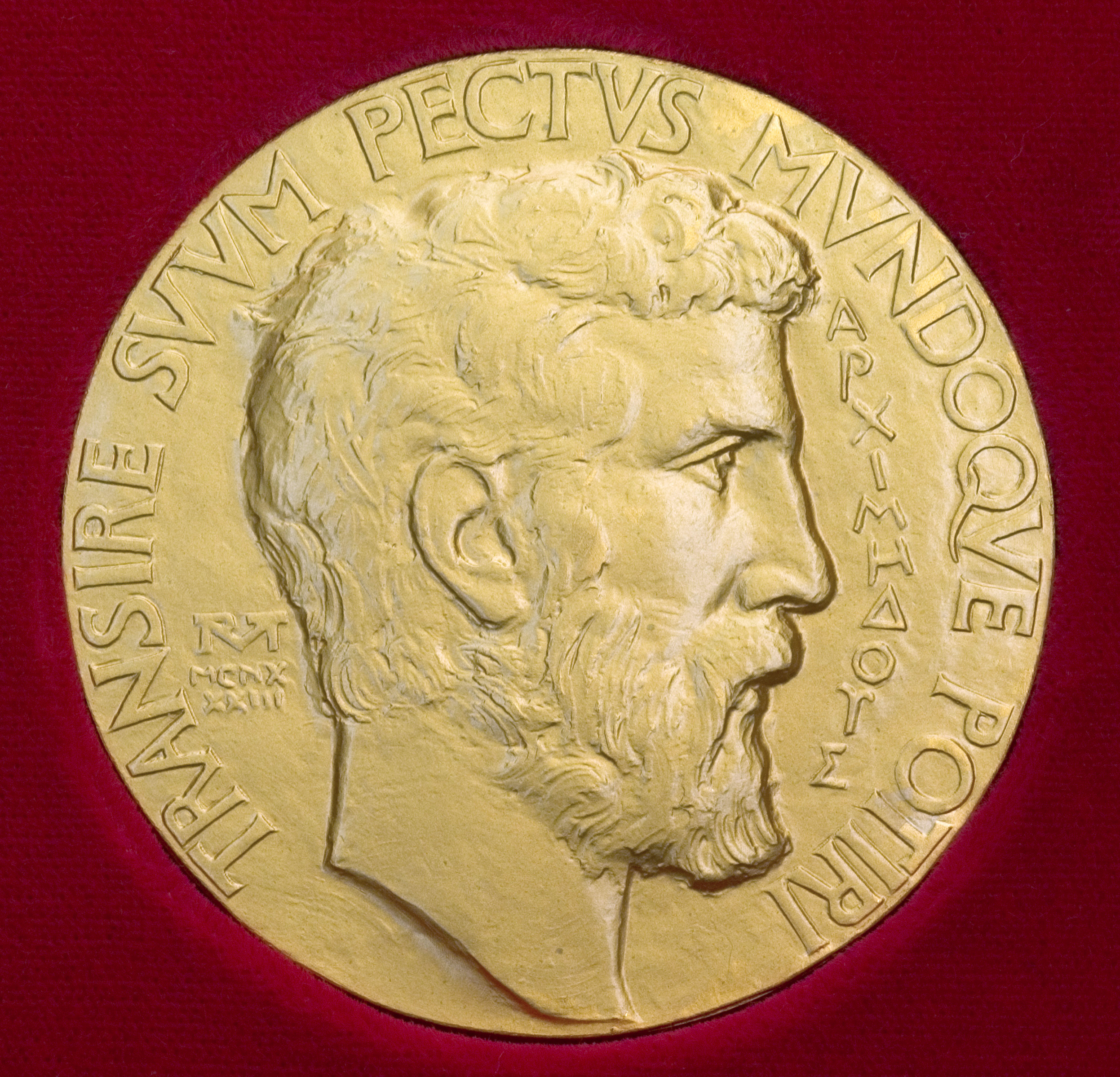
http://upload.wikimedia.org/wikipedia/commons/0/0c/FieldsMedalFront.jpg
Don't be proud of others' accomplishments; be proud of your own.
One day in the not so distant past, I started thinking about a phrase that we have all used at one point or another. We use it as a congratulatory statement, to acknowledge a person's accomplishment of a personal goal, and don't give a thought to what it actually means. You know the statement: "I'm proud of you!"

In the past year or so, I've completely stopped using this statement. Not because I don't feel the emotions that come with the concept of pride, but because I have come to the conclusion that pride is a deeply personal emotion for your own accomplishments, and no one else's. Let me give you a concrete example of what I mean.

I have several friends who decided a year ago to start eating healthier and going to the gym regularly. They are all showing massive progress towards their goals, and some have even reached their goal weights and are talking about taking it further; some have just decided to maintain what they have done now; some are still working very hard towards their goal.

I am so happy my friends who have reached their goal weight have done so. They have posted progress reports and pictures on Facebook, and when I see them in person they truly look amazing (the camera does no one any justice). I'll admit to a twinge of longing too, because I also want to get few extra pounds off.

These are remarkable achievements for anyone who is on the weight-loss journey. But by saying "I'm proud of you!" I feel like I'm taking ownership of some of that accomplishment away from the person who really owns it. I didn't help that person with anything but maybe some cheerleading along the way. Should I really be proud of being a cheerleader, saying words that come so easily when I see the product of that hard work, when someone else put all the work into their diet and exercise to lose their extra pounds?

When I look back over my own life, there are few goals that I'm truly proud of myself for achieving. It seems that more than a few of my accomplishments were set to make others happy. There are also a lot of times when pride stood in the way, or made me do things that ultimately I'm not proud of, and caused me heartache and pain.

A friend of mine once called me humble when we talked about my thoughts on pride. I don't think it's humility. I think it's acknowledging that pride is not an inherently good emotion; be proud of yourself, but be happy for your friends and family. Their accomplishments are not yours to claim. Congratulate them instead, and express your honest admiration for them, but don't take even the smallest bit of their own pride away.

26 May 2014

Stage Fright

http://kichiwall.com/wp-content/uploads/2014/01/music3.jpg
Music expresses that which cannot be said and on which it is impossible to be silent.
— Victor Hugo
My mother had this electronic keyboard that was set up next to her real piano, and for some strange reason, I was drawn to these instruments like a moth to flames, ever since I was a baby. I had putzed around a little bit on the piano, but playing seemed beyond my grasp. My mother played her piano with what seemed to me such grace and beauty, the way children think everything their parents do is perfect, but I still knew when she played the wrong notes, because it sounded "different" in my head.

Keep in mind that I was four, but I remember this bit really very clearly: I had made the connection between the pages that had this strange language on it and what it was she was playing, and could follow along, because the higher notes were higher on the bars on the page and the lower ones were lower on the bars on the page. One day, I noticed that the keyboard had the same language, spelled out in the "letters" of this language, above certain keys. There was also a translation, a Rosetta Stone as it were, above the letters of this language, C, D, E, F, G, A, B.

I had learned how to read in English by this time, thanks to my preschool teachers, so I knew the process of learning how to read. All I had to do was take that knowledge and apply it to this strange language. So I pressed those keys on that electronic keyboard, and listened to each of the notes. Since the keys were laid out in the same pattern above and below where these notes were written, I made the connection that they were the same note names. They also sounded similar, and when I pressed the same keys in the same place they made this wonderful "same" sound in my head.

OK, so this is my roundabout way of telling you that I taught myself how to read music. I remember it taking about a week to make these connections, and then another week to find a piece of music that was simple enough to read and learn, and then I was off to the races.

When we started going to church, I think I was around the age of six, I further learned how these notes worked. I learned how to make these notes into vocal song. I learned little harmonies, and how those notes worked together in those little harmonies. We did music in school, and the teacher there saw how I lit up when we sang in class. I think she knew what it meant to me — it was an escape. I continued singing in choirs throughout college, to the consternation of some, and the relief of others.

When I was nine, I started playing the violin. My little hands just weren't big enough for anything else. They still really aren't. I can't play a Corelli piece to save my life; I just don't have the stretch. It isn't a lack of talent, I'm sure my teachers would tell you that. I'll come back to the violin a little later in this blog.

I write all this to tell you about how anxiety has kept me back from fully enjoying the experience of making music. Anxiety will insinuate itself into the deepest corners of your mind, and try to destroy anything you hold most close to your soul. I love music so much because it is an escape, but it is also a trap for anxiety, my anxiety, to snare me.

To perform, you have to play and sing to an audience, and to advance your musical career, you have to play and perform alone or in a small group. I have had terrible stage-fright my entire life. I have blamed it on a fear of microphones in the past, but that isn't really true.

I can get up on stage and speak from no notes whatsoever on my other interests and passions, but playing or singing alone? I need encouragement beyond anyone's wildest beliefs. Why is it that I am so afraid of this, that I even have difficulty singing in karaoke?

This is what I've come to understand about myself: I am terrified, absolutely and unequivocally petrified, of being judged. I have always had what I think is an intense knowledge of what is going on around me at all times, and judgement by others. I'm hyper-aware of microexpressions in people's faces, and how they are responding to stimuli. My mother says she recognized this in me from a very young age, possibly back before I was even toddling around.

Singing or playing in a group is not an issue for me, but by myself is... I pour everything I have into music. Yes, it depends on the piece, but it is all about the expression of that music, the emotion behind the notes and the words and the dynamics, and it strips my soul bare for everyone with eyes to see it. It has to be perfect whether I'm singing melody or harmony, but it also shows my barest self, my naked self, my beautiful side and my ugly, my pain and my frustration. It shows me as I cannot hide, and leaves me vulnerable to those judging looks and staring eyes.

I confronted a part of that fright this weekend. I was a junior in high school, and I was singing in the choir then, but wasn't playing my violin much, just at home. After a performance, my mother gave me a proud-of-you-hug, and then she cut me to my core with one little statement: "You look like you're in pain when you sing." Then she turned and walked to the car.

This almost made me give up music for good. It stopped me in my tracks, and made me doubt every time I had ever sung, ever played, ever thought I was good at making music. I stopped thinking that I could possibly make a living at music, which many of my music directors thought I should pursue at college. I stopped thinking it was viable that I could help direct the children's choirs at church; I stopped thinking about advancing my talents and maybe sharing them with others. What was the point, when apparently all I conveyed was that I was in pain?

It took me 15 years to confront her about this little statement, and that it still makes me cry. I'm crying now, just writing about it. Her response was, "I thought it would help you. It helped a vocalist I once knew a long time ago, before I said it to you."

No, Mom, it didn't help. It hurt. It sliced into the one thing I knew I was good at, the one thing I knew beyond a shadow of a doubt I could do, could work hard at without failing, could escape into and find solace in and curl up into and release at the same time. It chopped up my heart into little tiny pieces and left them scattered the gym floor like bits of confetti left over from prom night. It shattered me.

I'm not blaming her entirely, because I could have just picked up the pieces and soldiered on. I did, after a fashion. I continued singing in choirs (I even got asked by the choir director in college to be a "ringer" my senior year, where I didn't get class credit for singing in his choir, and to move around from alto to soprano depending on where he needed an extra voice or to keep others on-key), and I participated in some remarkable ensemble pieces, and even minored in violin performance in college... but I didn't major in it. I didn't play or sing outside of school, beyond some drunken attempts to sing karaoke.

I sing in the car now. I've never been one to sing in the shower, but I could. I sing when no one's around to see my face. I want to sing in a choir again... I want to SING again... I know beyond a shadow of a doubt I'm good enough. But this time, I really am in pain.

23 May 2014

A Sense of Family? Maybe?

http://www.scotlandshop.com/Images/Tartans/Elliot-Ancient-8oz-wool-tartan-swatch_lg.jpg
Isn't our family's tartan pretty?
Coral and brown on a field of bright blue.
Ever since I was little, I remember there being an intense sense of family pride. This wasn't some vague notion of what we were as our little family unit — we were members of a glorious Scottish clan (and Irish, if we want to count my mother's maiden name), and whatever we did was to honor that name and the heritage of the Picts. My mother cross-stitched the family crest for my dad, and we always had a spot of the family tartan in the house.
http://www.thereivertrail.com/media/liddesdale/elliot_clan_crest.jpg
Here's the family crest. For those who are interested,
the Fortiter et Recte simply means "Boldly and Rightly."
I enjoy learning about Scotland and our family's role in Scottish history. It's not explored much in the history books, but those in the know know how integral our family was to Scottish independence. It also doesn't help that there was a fire in the 18th century that kind of destroyed the family record, but as far as anyone really knows we emerged as a clan (or family) with a tartan and chieftan, abruptly, in the 15th century. Maybe I'm descended from elves who decided to become mortal. Our clan is known for producing some "weird ones."

For all of the family pride and honor... I don't think I quite live up to it, especially the "Boldly" claim. I do have a strong ethical compass, which I know was inherited from both my parents, but which we blame on the Scottish genes. I've done some things in the name of family honor which no one knew about until I explained it, many years later.

The reality is that I wish I could go to Scotland and visit the land from which my ancestors came, and from where I feel this inexplicable draw originating. I've spent my entire life feeling like I didn't fit in, and I don't. Not quite. I might have to explore that concept a little further down the road.

I've never felt a sense of home. I know that's silly to read, but it's even sillier when you know that I grew up with my parents' marriage intact, a strong bond with my extended family, and that I love a great many friends all over the world, who are from any number of backgrounds, as if they were family. All that does not contribute to a sense of home for me.

Family isn't just my clan, or the people I happen to share genetic material with; home isn't just my family or the people with whom I live. It's deeper, stronger, and wider than all of that. I truly see my close friends as my family, and I see in them a need to do something more than what I am doing. What that is, as yet, remains to be seen — and perhaps I'll never know what it is.

Fortiter et Recte indeed.